
As retailers increasingly take on the role of media companies, the traditional boundaries between brand advertising and retail media teams are breaking down. Amazon's expansion into premium video and DSP gives CPG brands access to audiences across Prime Video, Twitch, Netflix, Roku, and Spotify, reaching 90% of U.S. households, according to Amazon. With more opportunities than ever to engage shoppers earlier and throughout the entire purchase journey, brands have to rethink how they allocate media investment.
But for many CPGs, brand advertising and retail media teams still plan from separate budgets, so each team measures success within its own channel. A retail media team may see a $4 click on a non-branded term like "paper towels" as a reasonable buy because it performs well against its search-specific benchmarks driving total sales, even though every brand in the category is competing for the same keyword. The problem is that this scorecard measures whether search worked, not whether search was the best use of the aggregate budget. Without comparing that $4 click with what the same investment could generate through display, social, or video ads driving shoppers to the same product detail page, teams have no reason to change their allocation. The result is a cycle in which each team optimizes its own channel and repeats the same spending pattern the next quarter.
Brands should objectively combine search, display, and video into one budget with shared goals and ideally invest in talent that understands each platform well enough to discern its impact against the business's overall objective. That way, teams can compare what a click costs across every format Amazon sells and put money where it performs best, rather than where each team can best justify it.
Why separate brand advertising and retail media budgets cost brands more
Teams responsible for retail media and those overseeing brand video advertising typically report to different leaders and have different performance goals. Even though both budgets belong to the same brand, the two teams optimize against different metrics: cost per click (CPC) and sales versus cost per thousand (CPM) impressions and reach frequency. That makes it difficult to evaluate the trade-off between platforms, so each team can see how its own tactic performed but not what the other paid to get a shopper to the same product page.
Teams are also individually motivated to improve their own scorecards rather than to determine whether the budget would've been better spent on the other team's efforts. For retail media teams, that can look like bidding more aggressively on non-branded terms because higher bids are one of the cleanest ways to improve reported search performance.
That separation carries into the following year's planning cycle, when each team uses its own performance metrics to justify its budget. Both cases hold up, since a retail media team hitting its cost-per-click target and a brand advertising team hitting its CPM target have each done what they were tasked with. The brand funds what each team can justify rather than what performed best across the two, and the split renews for another year.
What changes when brands manage one Amazon budget
Once one team controls both budgets, that team can compare the cost and potential value of each format before allocating budget toward the next ad. For example, a $6 CPM at a 1% click-through rate equates to $0.60 per click, well below a $4 non-branded search click. That comparison gives brands a basis for shifting spend when search becomes more expensive, rather than automatically bidding higher on competitive terms.
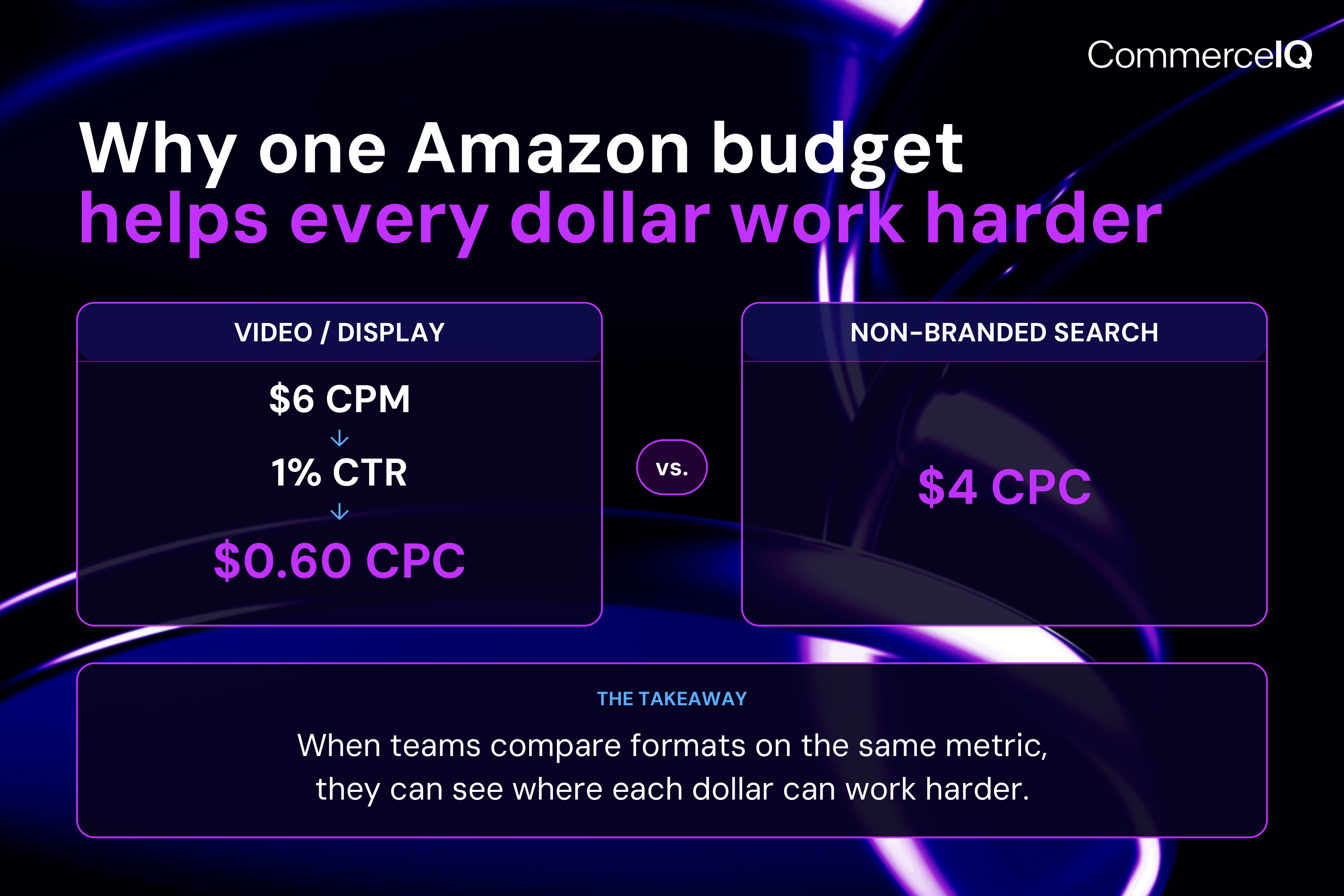
Brands can use metrics like CPC, click-through rate (CTR), CPM, placement, viewability, and audience type to show what each format delivered without requiring teams to resolve attribution first. The goal isn't to declare one format the winner but to evaluate where the next dollar can have the most impact.
Making these comparisons manually takes time and expertise, especially for brands running campaigns across multiple DSPs and vendors that each report results differently. An agentic retail platform can help by bringing search and DSP performance into one view and translating metrics like CPC and CPM into comparable costs. It can also recommend where to shift budget or automatically adjust bids, so brands can act on the comparison while campaigns are still running.
Brands managing one Amazon budget will pay less for every shopper they acquire
Every CPG brand buying Amazon media has access to the same formats, from search ads at the moment of purchase to video on Prime Video and the open internet, so access alone no longer separates one brand from another. What Amazon won't tell a brand is whether that budget would have done more in another format, or what the spend is doing to the brand's share in the category.
Brands that compare every format using the same metrics can make budget decisions that both teams can act on. An agentic retail platform like CommerceIQ connects DSP and search spend to shelf conditions, so teams can set one budget against one set of numbers instead of two.